
China's Manufacturing Outlook for the Next Five Years and a Digital Vendor Collaboration Framework
89.6% of China's large-scale industrial enterprises have undergone digital transformation, marking entry into the "deep water zone" of scaled adoption. Drawing on the latest 2026 policies and data, this article analyzes the trajectory of the next five years and proposes a three-layer collaboration framework for digital solution vendors.
Manufacturing Digital Transformation Enters the "Deep-Water Zone" of Large-Scale Adoption
According to the Manufacturing Digital Transformation Development Report (2025) released by the China Academy of Information and Communications Technology (CAICT), as of December 2025, 89.6% of industrial enterprises above designated size nationwide had carried out digital transformation, and the penetration rate of digital equipment had reached 57.7%. This means that manufacturing digital transformation has moved beyond the pilot-and-breakthrough stage into the "deep-water zone" of large-scale adoption.
Policy objectives have further clarified the pace for the next five years: in May 2024, an executive meeting of the State Council reviewed and approved the Action Plan for Manufacturing Digital Transformation, proposing that by 2027, industrial enterprises above designated size in major industrial provinces and cities and in key industrial parks achieve full coverage of digital transformation, and that by 2030, industrial enterprises above designated size strive to essentially complete one full round of digital transformation. In June 2026, the Ministry of Industry and Information Technology and seven other departments jointly issued the Implementation Opinions on Promoting the High-Quality Development of the Industrial Internet, proposing that by 2030, the added value of the industrial internet core industry exceed RMB 2.5 trillion, that 50,000 industrial 5G private networks be built, and that integrated applications achieve full coverage of all 207 medium-level industrial categories.
At the industry level, a tiered pattern of differentiation has taken shape. The automotive, shipbuilding, and electronic information manufacturing industries have the highest proportions of enterprises carrying out digital transformation, at 94.4%, 94.2%, and 93.9% respectively, placing them in the first tier; the consumer goods and raw materials industries sit in the second tier, where room for transformation remains broad. As of the end of 2025, more than 30,000 foundational-level smart factories, more than 1,200 advanced-level smart factories, and more than 230 excellence-level smart factories had been built nationwide, and China accounts for 45% of the world's 85 "Lighthouse Factories."
AI and Manufacturing Are Accelerating Integration, with Value Moving from Single Points to Systems
2026 is regarded by the industry as a year of deepened ascent for "manufacturing + AI." Artificial intelligence has been fully integrated into the core production systems of manufacturing enterprises—no longer merely an auxiliary tool for boosting efficiency, but the core vehicle driving new quality productive forces. Data shows that in 2026, the market size of China's manufacturing digital transformation is expected to exceed RMB 4.2 trillion, with the penetration rate of AI technology in the industrial field reaching 38%.
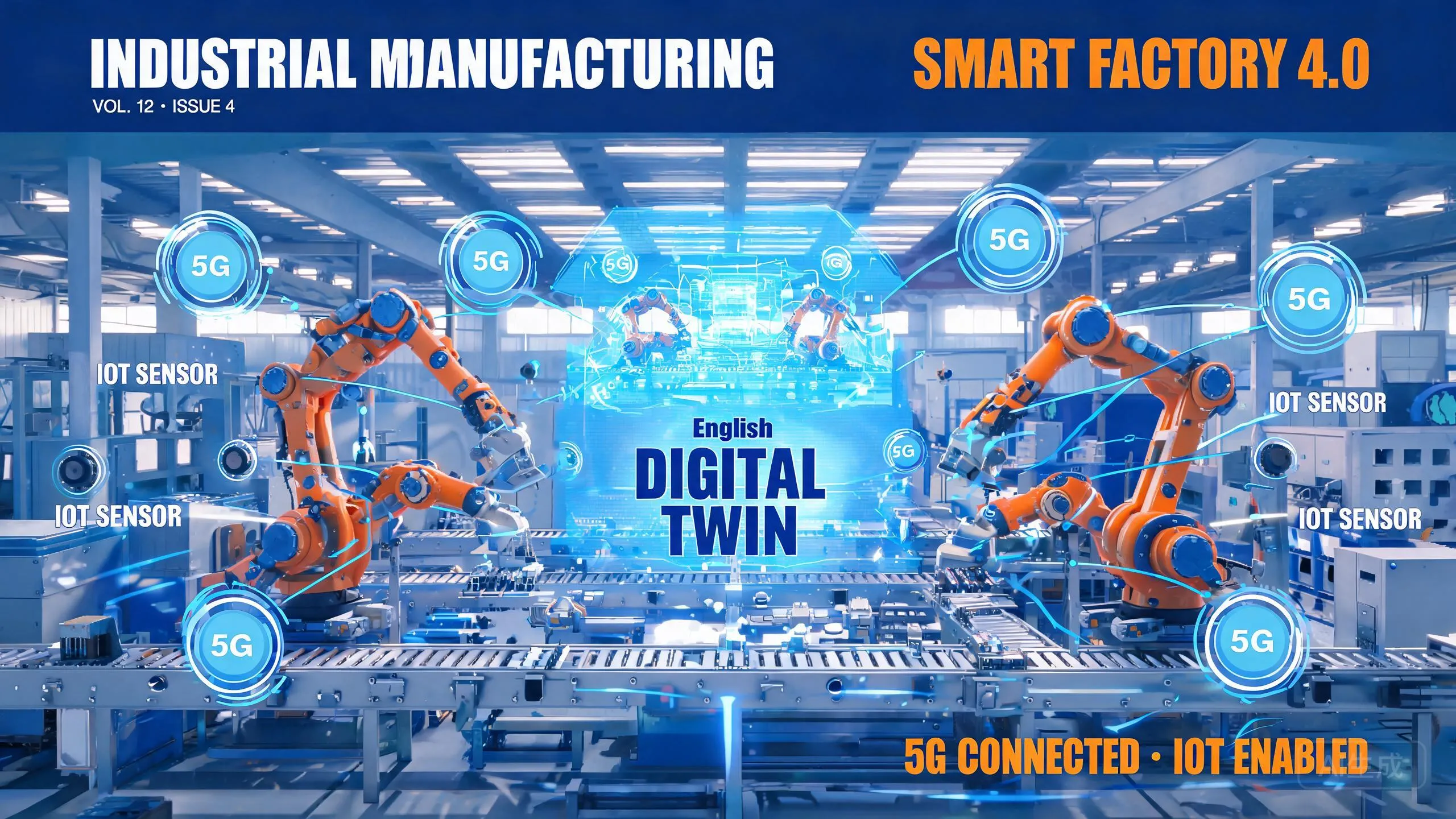
In terms of technology deployment, as of Q1 2026, 56 industrial vertical large models had been released in China, covering the full chain of R&D and design, production and manufacturing, operations and maintenance services, and supply chain management. AI visual quality inspection has achieved a defect recognition accuracy of 99.2% and has replaced more than 1.2 million human quality inspectors; AI predictive maintenance has reached an equipment fault prediction accuracy of 87%, cutting unplanned downtime by 45%; AI-assisted R&D has shortened new product development cycles by an average of 35%. There are now more than 3,200 digital twin factory demonstration projects, and the process verification cycle for new products has been reduced from an average of 6 months to 6 weeks.
Infrastructure has advanced in parallel. More than 12,000 "5G + industrial internet" projects have been built nationwide, connecting more than 98 million sets of industrial equipment, and the deployment of industrial edge computing nodes has exceeded 450,000. The share of revenue that enterprises devote to digital and intelligent investment has risen from 2.5% to between 3% and 3.5%, and the projected investment space for AI inference applications exceeds RMB 700 billion.
Digital Vendor Collaboration Framework: Three Layers of Capability Alignment to Navigate the Deep-Water Zone of Transformation
Facing the transformation window of the next five years, manufacturing enterprises need not isolated software tools, but integrated solutions that can connect the entire "equipment-data-application" chain. Collaboration between digital vendors and manufacturing enterprises should unfold across three layers.
Infrastructure layer: With the industrial internet as the foundation, advance the deployment of new infrastructure such as 5G private networks, edge computing, and identification resolution to enable equipment connectivity and data collection. For enterprises with a high proportion of legacy equipment, prioritize closing data collection gaps; for new production lines, embed digital capabilities from the design stage onward to avoid the sunk costs of "build first, retrofit later."
Platform and data layer: A unified architecture is the key to avoiding information silos. Take the five-layer unified architecture—intelligent sensing, intelligent connectivity, intelligent foundation, intelligent platform, and industry applications—as the blueprint, and unify data standards and system interfaces to support long-term iteration. The ongoing pilots of industrial data spaces have created conditions for the secure flow of data across enterprises, on which vendors can build trusted data collaboration capabilities.
Scenario and application layer: Focus on high-value scenarios, entering through small cuts and landing with great depth. The Reference Guidelines for Scenario-Based and Atlas-Based Advancement of Digital Transformation in Key Industries issued by the Ministry of Industry and Information Technology covers 14 key industries including steel and petrochemicals, with more than 10,000 "small, fast, light, and precise" solutions cultivated cumulatively. Vendors should build on industry knowledge graphs to customize a "one policy per enterprise" transformation path for each company, starting from mature scenarios such as equipment operations and maintenance, quality inspection, and supply chain collaboration, and building confidence in transformation through quick wins.
As for cooperation models, large and medium-sized enterprises are suited to the deep cooperation model of "customized development + long-term operations and maintenance," while micro, small, and medium enterprises are better suited to the lightweight model of "standardized products + SaaS subscription." A vendor's core competitiveness lies in whether it can deeply integrate industry know-how and AI capabilities with an enterprise's existing systems, so that digitalization genuinely serves cost reduction and efficiency gains rather than piling up technology concepts.
As a provider of digital and intelligent solutions deeply engaged in industrial manufacturing, smart energy, and other fields, Lingser Technology will continue to advance digital transformation together with its manufacturing partners in a scenario-driven, architecture-led, infrastructure-first manner, helping enterprises land precisely and move forward steadily through the deep-water zone of the next five years.