
HarmonyOS Market Share Data and Future Outlook
HarmonyOS devices have surpassed 32 million units, with an 18% domestic market share overtaking iOS. This article reviews key ecosystem data and looks ahead to HarmonyOS's 2026 shift from "scale expansion" to "quality deepening."
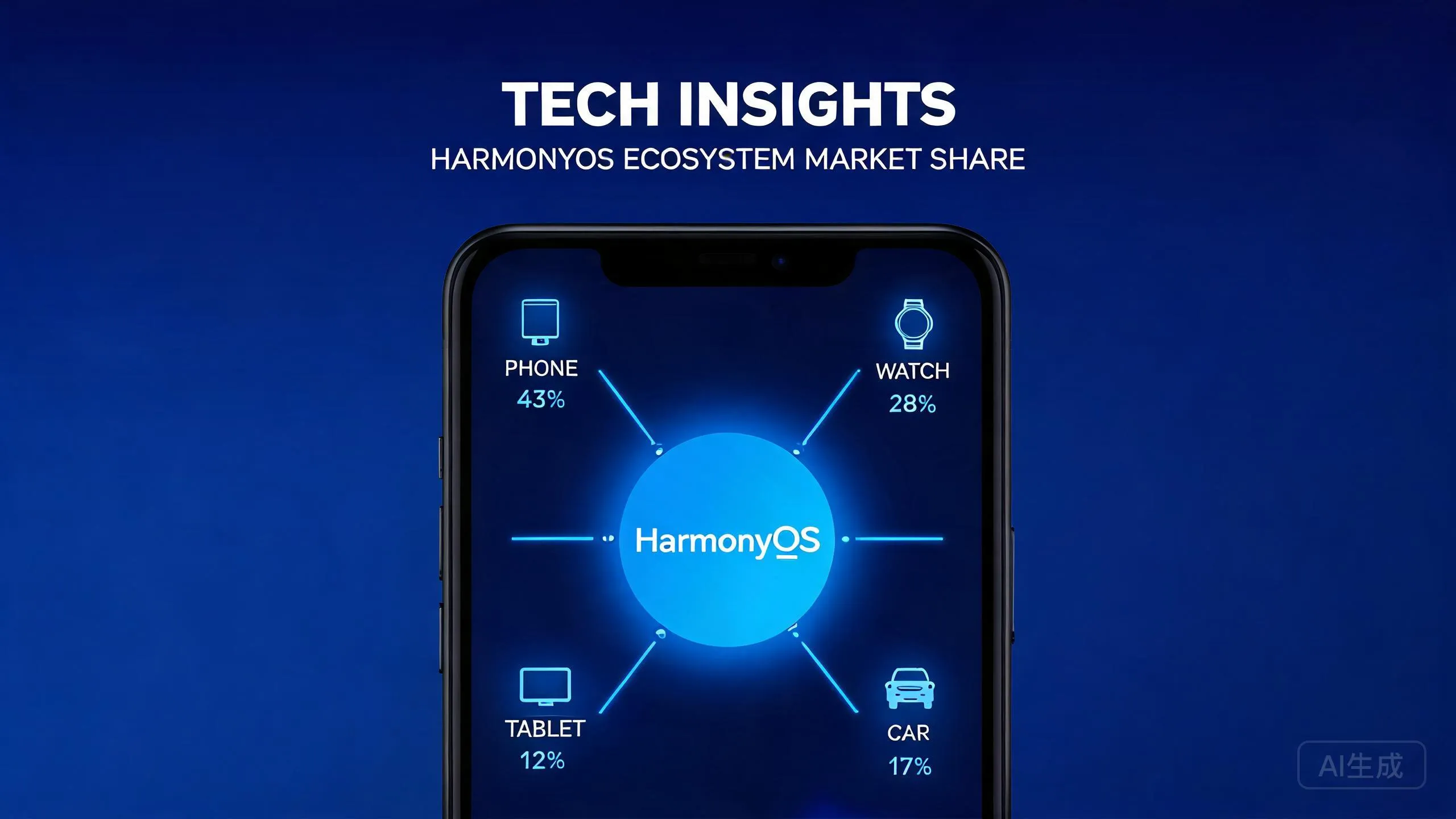
The HarmonyOS Ecosystem Crosses the Scale Threshold: From "Installed" to "Actually Used"
In December 2025, He Gang, CEO of Huawei's Device BG, disclosed at a new-product launch that devices running HarmonyOS 5 and HarmonyOS 6 had surpassed 32 million units. From 10 million units in July 2025 to 32 million at year-end, the ecosystem leapt by 22 million units in under half a year—more than 160,000 new devices per day on average—making it one of the fastest-growing operating systems in the history of smart terminals. This milestone marks the point at which the HarmonyOS ecosystem has officially crossed the critical threshold of scale expansion.
On the market front, Counterpoint data shows that HarmonyOS now holds an 18% share of China's smartphone operating system market, overtaking Apple's iOS and holding firm as the country's second-largest mobile operating system for seven consecutive quarters. Huawei's smartphone business keeps warming up—Mate 80 series sales in the first 15 days on sale reached 115% of the previous generation over the same period, and the nova 15 series has entered the market in strength on HarmonyOS 6. The recovery in handset sales directly lifts HarmonyOS installations, forming a positive feedback loop.
Ecosystem Building: Developers and Users Moving Toward Each Other
Installation figures are only one dimension; an operating system's vitality ultimately depends on whether developers are willing to come and whether users can actually find things to use. As of the end of 2025, the global HarmonyOS developer community had surpassed 10 million, the open-source community counted nearly 9,000 contributors, and cumulative code contributions reached 130 million lines. More than 350,000 HarmonyOS apps and services are available on Huawei AppGallery, the adaptation rate of China's TOP 100 mainstream apps stands as high as 97%, and flagship national apps such as WeChat, Alipay, and Douyin have completed the migration of their core features.
HarmonyOS's signature strength of "develop once, deploy across devices" has sharply reduced developers' adaptation costs—a single codebase can run across phones, watches, in-vehicle systems, and many other types of terminals. This is especially friendly to mid- and long-tail app developers, laying the technical foundation for the ecosystem to move from "covering core needs" to "covering needs across every scenario."
Outlook for 2026: Deepening Quality and Penetrating Industries
Entering 2026, the strategic focus of the HarmonyOS ecosystem has clearly shifted from "scaling up" to "deepening quality." Huawei is concentrating on advancing the OpenHarmony 6.1 LTS long-term support release, matching its stability to scenarios with exacting reliability requirements such as industrial equipment and government-service terminals, and lowering adaptation costs for ecosystem partners.
On industry deployment, HarmonyOS has achieved full coverage from consumer electronics to industrial control. China Energy Investment Corporation's "Kuanghong" (MineHarmonyOS) and China Southern Power Grid's "Dianhong" (PowerHarmonyOS) have landed one after another, and third-party distributions for government affairs, transportation, finance, and other industries now number 69. On the consumer side, HarmonyOS has taken the No. 1 market share in China's fully-furnished housing market for smart homes. As HarmonyOS Intelligent Mobility rolls out multiple new models, the seamless handoff between smart cockpits and phones will open up incremental markets in the transportation sector.
Huawei has set a target of surpassing 100 million terminal devices before winter 2026. The law of operating systems is that once the installed base crosses a certain threshold, developers' willingness to invest changes qualitatively—more apps make better experiences, better experiences attract more users, and a positive flywheel takes shape. The 100-million mark may well be the critical node at which the HarmonyOS ecosystem shifts from "quantitative change" to "qualitative change."
As a technology services provider deeply rooted in digital and intelligent solutions, Lingser Technology will keep a close eye on the industrial rollout of the HarmonyOS ecosystem, explore industrial IoT and cross-device collaboration applications built on OpenHarmony, and help manufacturing, energy, and other industries advance domestic substitution and digital upgrading.